

Note: This essay was written just before February 28. At the moment, missiles are raining amidst a militarized cognitive landscape, long-laid, funneling emotions and the public mind. Reflecting on the recent Executive Order of February 18, issued just 10 days prior to the initiation of kinetic war, the timing is remarkable. It reads like a scene in a play, a prologue, part of a tapestry, a coordinated pageant, preparing and reinforcing the public mind for war.
Funnels for the Mind
An Executive Order is not an off-the-cuff bit of scribbling by a single individual—it is always a work of carefully crafted word-smithing, aimed at justification and deflecting potential criticism. And in a great many instances, these orders have wide impact and continue to persist and exert influence well after the President who signs them has left office.
In the case of the Executive Order of February 18, we observe an example of the use of a device that has become all too common, but something we should expect to see more of: the cognitive funnel.
A cognitive funnel does not depend on strict logic or reason. They are employed because they are built on frames that leverage the unconscious mind.
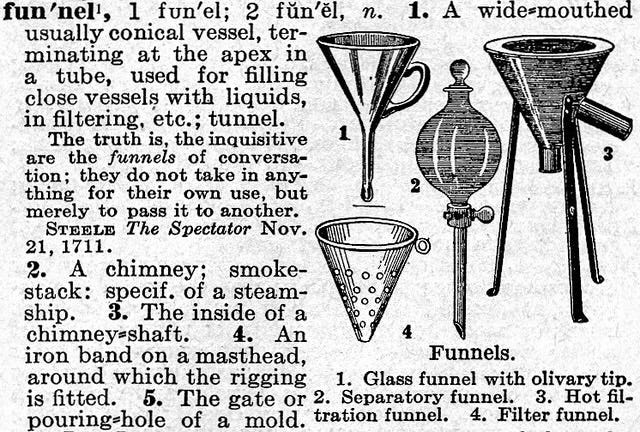
Consider the funnel—its purpose, how it functions.
The word ‘funnel’ comes to us via the Latin fundere, ‘to pour’.
Funnels are devices which take disorganized, loose material and direct this into a organized flow, usually into a container of some kind. Funnels channel by gravity, no impelling force required. The flow is inevitable, as long as the funnel opening is large enough to accommodate the material.
Funnels are incorporated into all sorts of devices to channel and shape output or merge together disparate ingredients, as in the example of a sausage maker.

Funnels may take distinct ingredients and combine them either sequentially (one after the other); or, in combination, serving as a crude mixing vessel, just prior to exiting the base of the cone. In such a case, true mixing and integration doesn’t actually happen; rather, it is only simple combination, association by proximity. This works best when the constituents are both fluids, or share similar characteristics, such as granular size.
In the case of a cognitive funnel, the elements in the funnel are bits of language—thought-memes—not complete arguments. And the flow is being directed not by gravity, but by the framing. The destination of the funnel is the mind.
George Lakoff, speaking to a group in 20041, said:
“Framing is about getting language that fits your worldview. It is not just language. The ideas are primary and the language carries those ideas, evokes those ideas.”
Continuing in that vein, he observed in his bestseller, Don’t Think of an Elephant! :
You can’t see or hear frames. They are part of what we cognitive scientists call the “cognitive unconscious”—structures in our brains that we cannot consciously access, but know by their consequences. What we call ‘common sense’ is made up of unconscious, automatic, effortless inferences that follow from our unconscious frames.
We also know frames through language. All words are defined relative to conceptual frames. When you hear a word, its frame is activated in your brain.
Examine the Language

Considering the Executive Order’s text, the first four words of the title establishes the frame: ‘Promoting the National Defense’. The underlying idea is to be taken as ‘common sense’, and functions like a funnel, evoking unquestioned acceptance of the elements that are subsequently poured into the funnel—elemental phosphorous and glyphosate-based herbicides.
National Defense, like National Security, are carefully cultivated frames.2
The first paragraph of Section 1 addresses elemental phosphorous:
Elemental phosphorus is pervasive in defense supply chains and is therefore crucial to military readiness and national defense. It is a key input in smoke, illumination, and incendiary devices and is a critical component for manufacturing the semiconductors that are central to numerous defense technologies, such as radar, solar cells, sensors, and optoelectronics. It is also increasingly important in modern lithium-ion battery chemistries used in a multitude of weapon-system supply chains.
The very next paragraph mounts the conceptual side-car, piggy-backing on the first: glyphosate-based herbicides:
Elemental phosphorus is also a critical precursor element for the production of glyphosate-based herbicides, which play a critical role in maintaining America’s agricultural advantage by enabling farmers to efficiently and cost-effectively produce food and livestock feed. As the most widely used crop protection tools in United States agriculture, glyphosate-based herbicides are a cornerstone of this Nation’s agricultural productivity and rural economy, allowing United States farmers and ranchers to maintain high yields and low production costs while ensuring that healthy, affordable food options remain within reach for all American families.
Two paragraphs later, a conclusion is drawn via the sequential association, like pouring one ingredient after another through a funnel:
Ensuring an adequate supply of elemental phosphorus and glyphosate-based herbicides is thus crucial to the national security and defense, including food-supply security, which is essential to protecting the health and safety of Americans.
Elemental phosphorous, as a component of weaponry, may be legitimately deemed a defense industry priority, but glyphosate-based herbicides are clearly not. This is, incidentally, not the first time that a pesticide or herbicide has been characterized as such.
In the very next sentence, the deeper motivation of this Executive Order is revealed, but like a slight-of-hand trick, only if one is paying close attention:
Nonetheless, the United States’ ability to domestically produce those critical inputs is extremely limited. Indeed, there is only a single domestic producer of elemental phosphorus and glyphosate-based herbicides…
That single domestic producer—though unnamed—is none other than Bayer.
The Defense Production Act of 1950
It is important to underscore here that this Executive Order is predicated on invoking the Defense Production Act of 1950 (DPA).
The DPA was originally based on the War Powers Acts of World War II (1941 and 1942). The War Powers Act of 1941 was intended to expedite the US war effort following the events at Pearl Harbor. The War Powers Act of 1942 granted additional wartime executive powers, allowing for acquisition of land for military purposes and war-related production contracting. Passed at the start of the Korean War, the DPA was also geared toward a war mobilization effort.
Since that time, the fate of the DPA has closely paralleled that of the expanding and expansive usage of terms like ‘National Defense’ and ‘National Security’.3
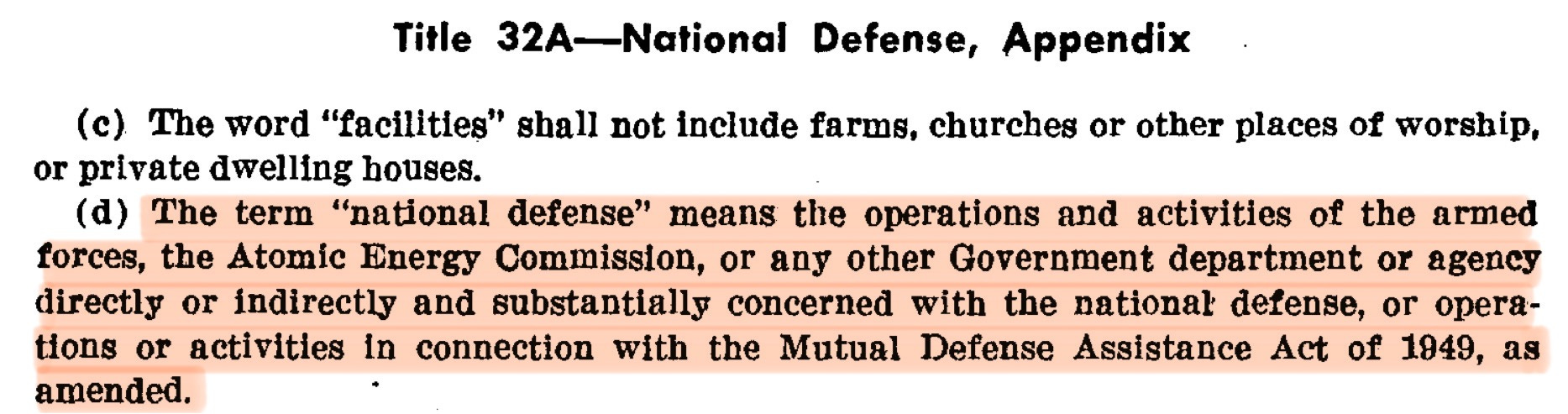
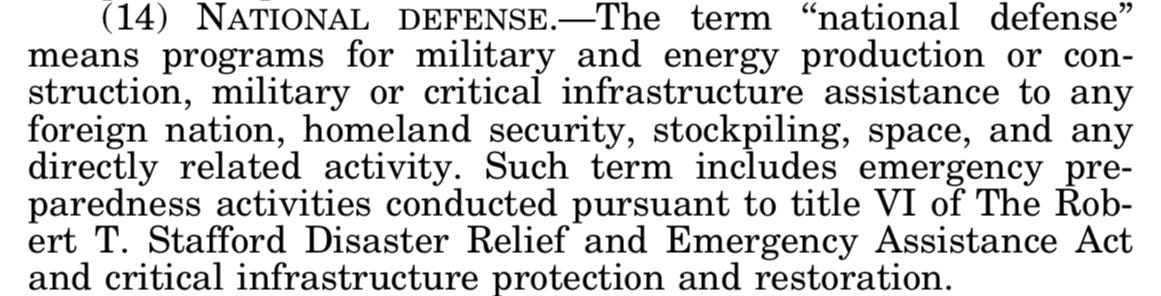
In parallel, the concept of ‘war’ has similarly undergone a transformation.
‘War’, as many are aware, is a declaration to be made by Congress, and is not a power of the Executive.
At one time, this was actually somewhat adhered to. Constitutional declaration by Congress for war was made for the War of 1812, the Mexican-American War, the Spanish-American War, World War I, and World War II.
In contrast, Korea, Vietnam, Laos, Cambodia, the Persian Gulf, Bosnia, Afghanistan, Iraq, Libya, and the entire Global War on (of) Terror have no actual declaration of war, being funded and executed under Congressional Resolutions and Authorizations, or UN Security Council Resolutions.
All of the kinetic military action taken since World War II, it can be argued, has been perpetrated in violation of the Constitution.
In this long context of seemingly ‘endless undeclared war’, the DPA has become a political and weaponized tool for the Executive. It has for quite some time functioned as a political, legal, and economic cudgel, wielded to bypass the Constitution.
At the outset, the DPA’s early influence on steel, aluminum, titanium, and mining are unsurprising. The DPA, however, quickly morphed into a changeling as language and words were stretched and contorted to meet political ends.
By the late 1960’s, the Act had been used to fund projects in the energy sector, including the trans-Alaskan pipeline and research into liquified natural gas. In the 1980’s, the Department of Defense began using the Act to fund development of a range of technologies, including silicon carbide ceramics, gallium arsenide semiconductors, microwave power tubes, and metal composites.
The 21st century saw still more expansion into wider realms.
Under Clinton, the DPA was invoked in California to force gas suppliers to continue to service Pacific Gas & Electric, despite non-payment by the company.
Under Obama, the Act was employed to force telecommunications companies to reveal confidential network information to the Commerce Department in a publicized effort to combat ‘chinese cyberespionage’.
In Trump’s first term, the Act expanded to the public health arena. It was used to designate products ‘essential to national defense’, including adenovirus vaccine production. During the spring of 2020, the Act was further employed to designate ventilators as PPE—essential to national defense—and thereby compel private companies to secure supplies to manufacture ventilators. The Act was later employed in April to compel meat and poultry plants to maintain production.
When Biden’s term began, the Act was leveraged to increase surgical mask production and secure equipment for manufacture of the Johnson and Johnson COVID injectables. Later in September 2021, the Act was again invoked to increase fire hose production in response to wildfires in California. The DPA was further used to increase extraction of minerals used in electric vehicles and batteries: lithium, nickel, cobalt, graphite, and manganese.
2022 saw the Act invoked again, but this time directed at infant formula. The Act was employed to require supply manufacturers to prioritize infant formula ingredients. The USDA and DHHS were actually authorized to use DOD aircraft to import formula from other nations.
Biden invoked the Act toward multiple and diverse efforts, including, heat pump manufacturing, hypersonic jet propulsion, and printed circuit board manufacturing. Toward the end of 2023, Biden would invoke the Act again to aid the pharmaceutical supply chain, especially for medical countermeasures and injectable products.
Over a period 75 years, the DPA has gone from being applied to steel for battleships to baby formula and surgical masks.
The public hardly ever questions these kinds of actions, because…National Defense!
Both ‘National Defense’ and ‘National Security’ are Words of Forbiddance.4
They act as cognitive no-trespassing signs: “Don’t Ask Questions.”
The mutability of ‘National Defense’ is, of course, intentional. Mutability is a key attribute of a Word of Forbiddance, precisely because it is an instrument of power, and its interpretation is meant to be defined by those that wield it.
Like ‘National Security’, ‘National Defense’ also represents a vast monetized network of tremendous influence and interests that includes officials (both elected and unelected), various government departments and agencies (including the Commerce Department — which may surprise many Americans). It also, significantly, includes many ‘public-private partnerships’; most notably, military contractors, the largest corporations, and central and international banking concerns.
By the official precedent laid here by this Executive Order, it now includes glyphosate and Bayer.
For researchers in this area, this is no surprise.
Chemistry in the Service of War
Organophosphate chemistry was pioneered by Dr. Gerhard Schrader. In 1936, he synthesized the world’s first nerve agent, Tabun. Schrader’s research would go on to be funded by the Nazi Party and produced the infamous poisons known as Sarin, Soman, and Cyclosarin. Schrader has been referred to as the ‘Father of Nerve Agents’.
Schrader was an employee of what was, at the time, the world’s largest chemical cartel, the conglomerate known as IG Farben. Founded in 1925, IG Farben merged together six german chemical companies, including BASF, Bayer, Hoechst, Agfa, Griesheim-Elektron, and Weiler-ter Meer.
Among IG Farben’s noteworthy contributions to the Nazi war effort were Leuna gasoline derived from coal hydrogenation, Buna-N butadein-sodium for synthetic rubber, aviation fuel for the german Luftwaffe, and the infamous Zyklon B gas used in the gas chambers. Fueled by slave labor, the company used its resources, technical capabilities, and contacts for the Nazi war machine. The company reaped huge profits.
The Bayer group at IG Farben is infamous for conducting medical experimentation at the Auschwitz and Birkenau camps.
IG Farben would be seized and liquidated at the end of the war, but the technology it pioneered would find its way forward, channelled by efforts such as Operation Paperclip. The IG Farben Trial had 23 company executives in the dock for war crimes and 13 were convicted. By 1951, all were let go on early release. Four companies emerged following liquidation: BASF, Agfa, Celanese AG5, and Bayer.
Glyphosate is a type of organophosphate compound. It was first developed in 1950. The first patent for its use in 1964 was as a pipe cleaner, due to its ability to bind minerals. It was later patented as an herbicide in 1971 by Monsanto, and sold commercially by Monsanto in 1974. That patent expired in 2000.
Bayer would go on to purchase Monsanto in an all-cash deal for $63 billion—the largest cash deal in corporate history. The purchase would make Bayer the largest agricultural company in the world.6
Following the acquisition, Liam Condon, head of Bayer’s Crop Science Division, would trumpet: “The Bayer cross is a global icon of trust and quality.” He would add, “The real winner in this transaction is going to be the grower who is going to see more innovation.”7
The corporate history of Bayer is deeply intertwined with war, especially chemical warfare.
And Monsanto is no stranger either. The Vietnam War saw some of the most egregious chemical warfare let loose on a civilian population in the form of Agent Orange. Despite its intended use as a defoliant on dense foliage, the compound wrecked havoc (and continues to) on human beings, combatants and non-combatants alike.
Not without irony, the mechanism that was used to conscript companies like Monsanto and Dow into producing Agent Orange for the US Military was none other than the Defense Production Act of 1950.
Courts have continued to rule that companies like Monsanto cannot be held responsible for the development and use of Agent Orange during the war.
The Socialization of Risk and Harm
In this context, the words of the Executive Order take on a different flavor.
Less benevolent.
Less patriotic.
Less noble.
The words are leveraged like weapons, selected and used for a reason.
The end result of these words isn’t just policy.
It is on a fundamental level, an effort to shape the public mind in a climate of war: justifying the continuance of harm by a demonstrated poison under the ‘virtuous’ justification of National Defense.
This is effectively a means of socializing risk. It demands the public bear the burden of harm under cover of a perceived virtue.
The flip side is entirely cynical. It is the privatization of return. Bayer will continue to profit under an aegis of perceived virtue.
The virtuous frame is the funnel used to sell both profit and risk.
If this triggers cognitive dissonance, it ought to.
The words we use matter. The ideas that frame them, the cultural norms and mythologies surrounding them, matter. They matter because they have the power to shape preconceptions. They shape reaction, even before thought.
And that’s worth reflecting on.
There are cognitive funnels everywhere—learn to recognize them.
And always, read between the lines.
-
#intertwine
#questioneverything
“You can’t see or hear frames. They are part of what we cognitive scientists call the ‘cognitive unconscious’—structures in our brains that we cannot consciously access, but know by their consequences. What we call ‘common sense’ is made up of unconscious, automatic, effortless inferences that follow from our unconscious frames.”
~ George Lakoff
If you like what you see, and you’re willing and able, consider leaving a tip. Every little bit helps. Thank you!
Related:


A discussion of some of the manifestations of this can be found here:

For comparison of the 1951 and 2025 versions of the DPA, see:
https://www.loc.gov/resource/cfr.cfr1951006-TDefense/?pdfPage=23
https://www.govinfo.gov/content/pkg/COMPS-8323/pdf/COMPS-8323.pdf
Cenaese AG would merge with Rhone-Poulenc to form Aventis, which later merged with Sanofi-Synthelabo to become the modern-day Sanofi.
The War Powers Resolution of 1973 isn't quite as blurry as the manipulation of language in the support of the Defense Production Act use by the Trumo administration. Nevertheless, the WPR-1973 is often ignored if recent history serves as a benchmark.
Here's our present WPR timeline:
February 28, 2026 → U.S. enters hostilities.
March 2 → 48-hour War Powers notification deadline.
April 29 → 60-day authorization deadline.
May 29 → final withdrawal deadline (90 days total) if Congress doesn’t authorize.
Any bets as to how this one will go?