
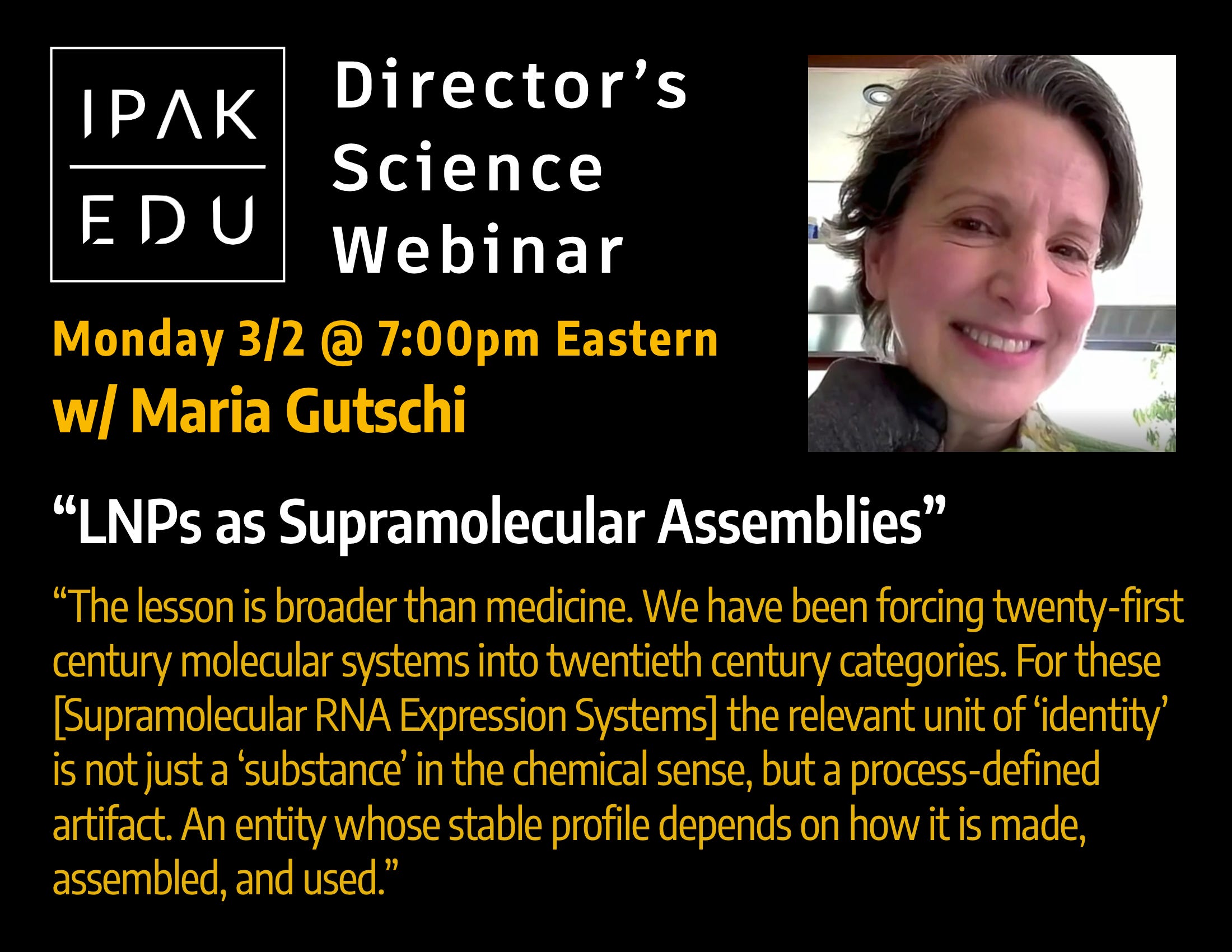
IPAK-EDU Director’s Science Webinar
Monday 3/2 @ 7:00pm Eastern
w/ Maria Gutschi, PharmD
“LNPs as Supramolecular Assemblies”
Maria Gutschi returns to the webinar for what promises to be an engaging and critically important re-examination of the lipid nanoparticle platform.
An excerpt from Maria’s substack:
What Are They, Really?
The category error at the heart of the RNA–LNP debate
For three, no its been four years, I tried to understand what these products do. Now it is clear the prior question is: what are they? Not as “vaccines,” “gene therapy,” or “prodrugs,” but in, and of, themselves.
Effect follows form. In the classical tradition from Aristotle through Aquinas, a thing’s form, that is, its intrinsic organizing principle grounds what it can do, the operations it can perform, and the effects it can produce. A cause cannot give what it does not have. Fire gives heat because heating belongs to its form. Living things generate their like, because they share the same kind of substantial form.1
When we misname or obscure the form, we blind ourselves to the real range of possible effects, intended and unintended. Ontology, in that sense, is not an optional philosophical game but necessary for practical reasons, risk assessment, and regulation.
When we misname or obscure the form, we blind ourselves to the real range of possible effects, intended and unintended. Ontology, in that sense, is not an optional philosophical game but necessary for practical reasons, risk assessment, and regulation. Instead of asking “what is this, in itself?” many of us settled for pragmatic labels chosen for regulatory convenience or public reassurance. We called them “vaccines,” “gene therapy products,” “platforms,” or just “shots.” And then we were surprised and confused when the effects didn’t line up with the label. Because the label was never an honest description of the form driving those effects.
I believe this reflects the quiet break with the older natural‑law way of thinking that once ordered medicine, law, and ethics, where naming followed nature rather than marketing or policy. We see this all around us.
Part I: Why “gene therapy” is the wrong fight
It’s tempting to call these products gene therapy. I called them gene therapy products myself. After all, they instruct cells to produce proteins and have genetic material enter the cells in a process called transfection. They certainly were not vaccines and I used this gene therapy product definition to help clarify their effects.
But I now believe this label misleads. In practice it suggests deliberate, stable modification of the genome in the public imagination, and it pulls us toward the wrong mental model: ex vivo or in vivo gene replacement aimed at permanent correction. These modRNA–LNP systems were not designed to operate that way, even if genomic alteration can occur as an unintended process artifact rather than an essential feature of their form.2
But I now believe this label misleads. In practice it suggests deliberate, stable modification of the genome in the public imagination, and it pulls us toward the wrong mental model
Arguing over whether they are gene therapy, or gene therapy products is just naming theatre and obscures things, imho. We really haven’t solved this question in the last 4 years. That is because, the real question is ontological. What kind of entities are they really?
Technical note: As we all know, plasmid‑derived residual DNA and SV40 promoter sequences in certain mRNA–LNP lots have been documented. These fragments originate from the DNA templates and bacterial elements used during plasmid amplification and transcription. Whether and how such fragments persist or integrate depends on multiple variables such as fragment size, methylation, co‑localization with nuclear membranes, and how well the cell repairs itself. These are manufacturing process-related artefacts, not intentional genomic edits, which is precisely why the manufacturing protocol is inseparable from the object’s biological identity, and why ontology here includes process, not just composition.
Part II: Why “mRNA as prodrug” helped and where it breaks
The “prodrug” lens brought clarity. David Wiseman and I used it many times (edit from David and Siguna. The concept of the pro-drug nature was made by Cosentino in this article3, and then explicity by Helene Banoun in her great article on gene vs vaccine4 after we used in among ourselves for a bit. Thanks you two!) It made eminent sense. It framed mRNA as a precursor that is delivered, translated transiently into a protein (spike here), and then cleared, which helped us reason about dose, kinetics, and even frameshifted translation products.
Ignoring the nanoparticle’s own activity blinds us to half the pharmacology.
But it also misleads if taken too far. Classical prodrugs are small molecules that rely on well‑characterized metabolic transformations in relatively stable environments. The modRNA-LNP system relies on emergent supramolecular structure. The lipid nanoparticle dictates biodistribution, cellular entry, and immune activation. Ignoring the nanoparticle’s own activity blinds us to half the pharmacology. “mRNA as prodrug” helps for part of the story but erases the LNP carrier as an active participant
Part III: What Onpattro taught us about RNA–LNP systems
Onpattro, the first approved RNA–LNP therapeutic, is the clearest guide. In its regulatory assessments, patisiran is described not as “naked siRNA plus excipients” but as siRNA formulated with four specific lipids into nanoparticles that determine uptake into hepatocytes, tissue exposure, and pharmacokinetics.5
Studying Onpattro taught me that RNA in this context is never “just” RNA. The RNA lives inside a designed supramolecular assembly. The “drug” behaves as a whole system in motion. It self‑assembles in microfluidic mixing, remodels in plasma, slips through fenestrated endothelium, gets bottlenecked in endosomes, and trafficked via exosomes. Tiny changes in sequence, lipid composition, or purification can shift this behaviour dramatically. That should have been the paradigm shift: the object of pharmacology here is a dynamic RNA–LNP system, not a single molecule.6
That realization should have been the paradigm shift. Instead, it was treated as a footnote.
Part IV: The true object: a process-defined supramolecular expression system
These products are best understood as process‑defined supramolecular expression systems, not static “drugs” or “excipients.” Their identity is defined by their manufacturing, structure and dynamic behaviours, not as vaccines or gene therapy.
Chat GPT defined the object for me as:
A process-defined, supramolecular drug-device hybrid designed to transiently reprogram protein expression via intracellular delivery of a synthetic RNA payload.
Whew. That’s a mouthful, isn’t it?
Process‑defined: Their identity (or form if you will) is inseparable from manufacturing and formulation. Small shifts in plasmid design, impurities, lipid ratios, or mixing conditions can create measurably different biodistribution, immune activation, and persistence. The process is the product. This is why process 1 and process 2 (and the shift to the Tris buffer or Process 3) is so fundamental.
Supramolecular: Lipid nanoparticles are not inert envelopes; ionizable and helper lipids, cholesterol, and PEG‑lipids self-assemble into a nanostructure with emergent properties that exhibit specific organ tropism, endosomal escape, adjuvant-like effects, and tissue‑specific toxicity.
Expression systems: The biological outcome depends on the RNA cargo and the cellular and tissue context that receives it. Different cells do not see the same number of particles, do not express at the same level, and do not respond identically to the same mod-LNP particle.This shifts the conversation from “what is it supposed to do?” to “what is this object, and what behaviours are built into its form, given how it is made?”
So to capture this, may we can call them either Supramolecular RNA Expression System or SuREX, which might be a little more memorable, lol.
There are other options in a poll at the bottom of the post.
But what I want to convey is that this “product” is a temporary molecular program. It is information which is encoded in RNA together with the lipid nanostructure, is executed by living cells, and eventually degraded (or not) through decay, redistribution, and immune clearance, all of which are still poorly characterised. What matters most is not composition alone but behaviour. And that behaviour is determined by the manufacturing process.
Part V: Why effects cannot be understood without ontology
Effects follow form. As long as we fail to describe these products, our observations will look like noise. Regulatory models built for stable small molecules and simple biologics like vaccines cannot capture systems whose function is emergent, context‑sensitive, and partially or wholly self‑assembling.
So when the modRNA-LNP particles behave “unpredictably,” they are not misbehaving; they are behaving as they were designed and made, and as their form and process permit. It is our conceptual and mental model that is inadequate, not the system that is anomalous.
The New Year is a natural time to reflect. Before talking about efficacy or adverse effects, I needed to understand the entire entity. This has been my mission from the start. It has taken me a long time. Only now am I beginning to see how and why it behaves, sometimes in ways that surprise us all. Especially after working with Genervter Bürger who turbo-charged my understanding. And only then, can we determine what efficacy there is and what adverse effects occur and how to treat or manage such effects.
Part VI: The epistemic correction
The lesson is broader than medicine. We have been forcing twenty‑first‑century molecular systems into twentieth‑century categories. For these “SRESs” the relevant unit of “identity is not just a “substance” in the chemical sense, but a process‑defined artefact. An entity whose stable profile depends on how it is made, assembled, and used.
In this regard, control and comprehension depend on understanding the process itself:
inputs (plasmids, RNA, lipids, contaminants),
assembly dynamics (microfluidics, mixing regimes, self‑assembly),
the energy and charge landscape (pH, ionizable lipid state, membrane interactions).
Recognizing these products as process‑defined systems reframes pharmacology. Instead of only cataloguing static compounds, it must follow a series of biochemical and biophysical events through time. That may sound like rewriting the pharmacology textbooks of which Genervter Bürger and I have been accused. Perhaps it is, but the behaviour of these RNA–LNP systems already forces us in that direction.
Read the full article at Maria’s Substack.

Links from the archive
Once a week, this webinar series brings a focus to science as it applies to public issues of concern. The webinar brings to you expertise from scientists, researchers, data analysts, medical professionals, health advocates, attorneys, and more, all with the opportunity to learn, ask questions, and hear directly from people working at the leading edge.
Join us!

If you like what you see, and you’re willing and able, consider leaving a tip. Thank you!
Very interesting presentation. Thanks, Maria. Gene Balfour