
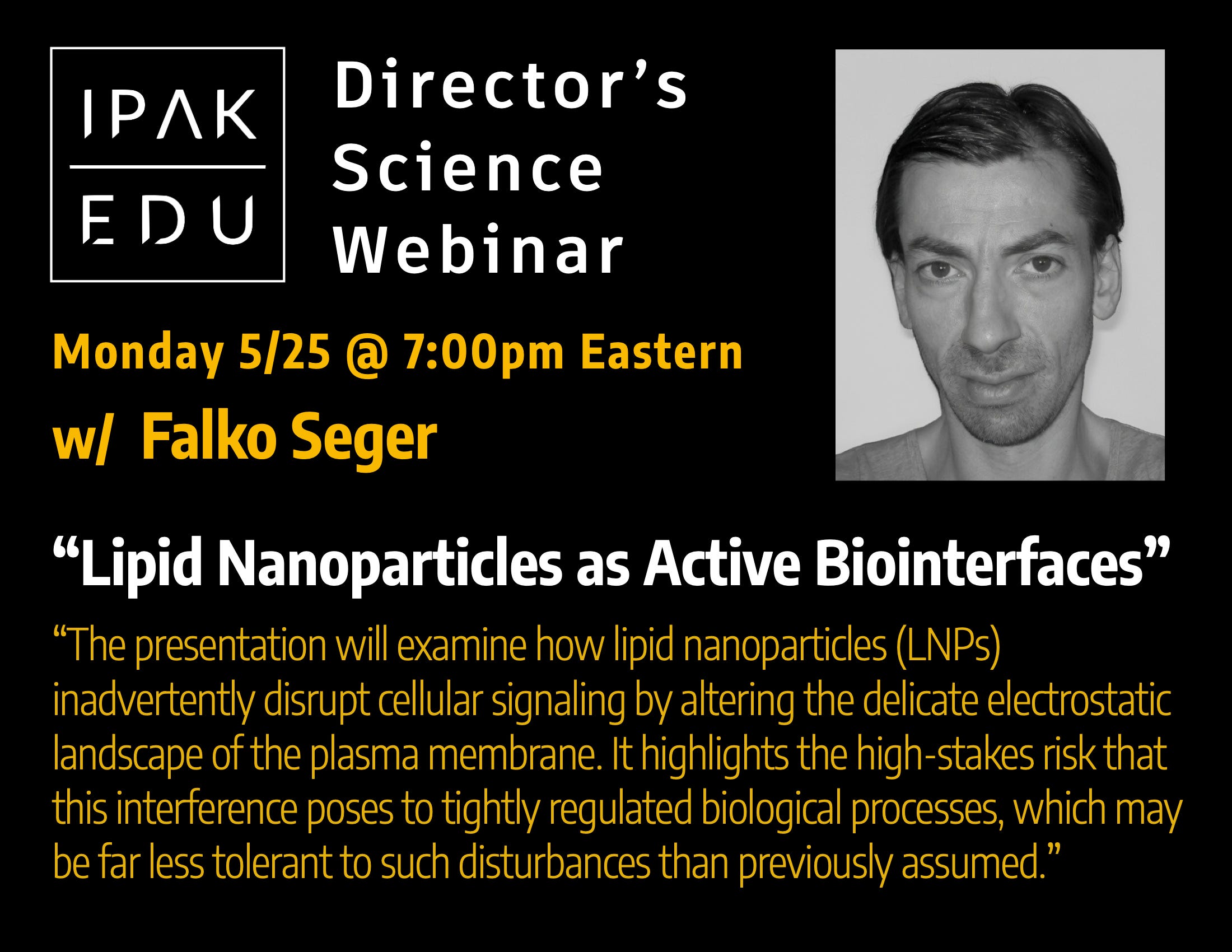
IPAK-EDU Director’s Science Webinar
Monday 5/25 @ 7:00pm Eastern
w/ Falko Seger
“Lipid Nanoparticles as Active Biointerfaces”
Join us!
“The presentation will examine how lipid nanoparticles (LNPs) inadvertently disrupt cellular signaling by altering the delicate electrostatic landscape of the plasma membrane. It highlights the high-stakes risk that this interference poses to tightly regulated biological processes, which may be far less tolerant to such disturbances than previously assumed."
Lipid Nanoparticles as Active Biointerfaces: From Membrane Interaction to Systemic Dysregulation
Falko Seger, L. Maria Gutschi, Stephanie Seneff *
Abstract
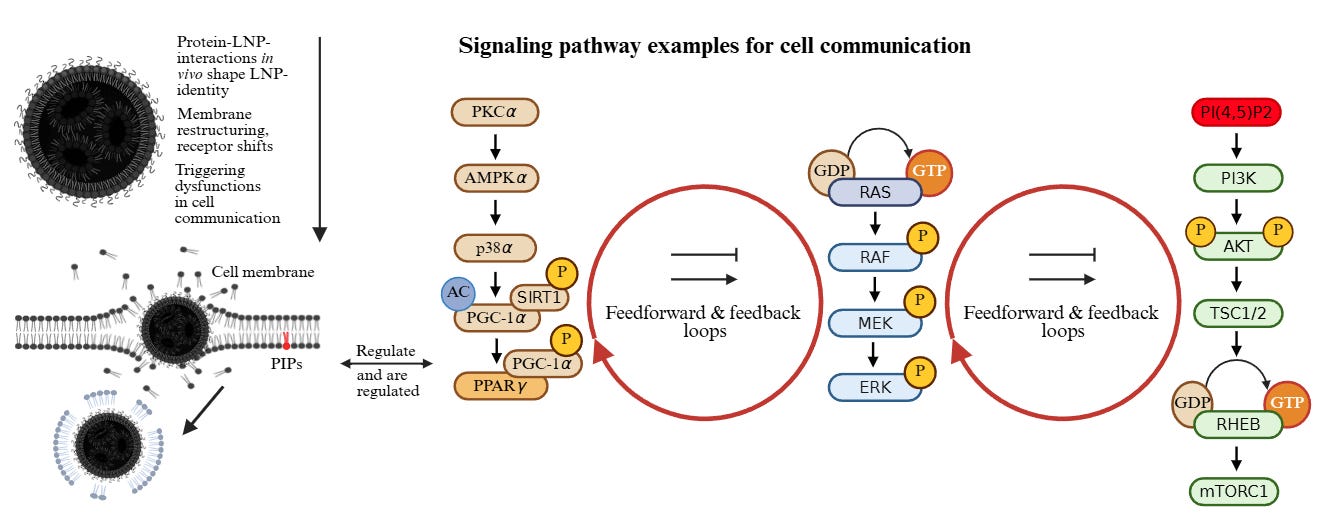
Lipid nanoparticles (LNPs) are central to modern mRNA therapeutics, including COVID‑19 vaccines. Far from passive carriers, their ionizable lipids actively interact with cellular membranes. Evidence from cellular, transcriptomic, and proteomic studies indicates that LNPs, with or without nucleic acid, alter gene and protein expression, thereby initiating inflammatory, detoxification, and stress responses at the membrane. Key pathways affected include lipid metabolism and detoxification, with roles for Peroxisome Proliferator-Activated Receptor Gamma (PPARγ) and cytochrome P450 enzymes. We hypothesize that the phosphatidylinositol (PI) cycle is the primary site of LNP-induced perturbations, regulating membrane restructuring and organelle trafficking during endocytosis. Disruption of this cycle triggers downstream signaling cascades, including Nuclear Factor kappa B (NF-κB), Mitogen-Activated Protein Kinases (MAPKs), Janus kinase/signal transducers and activators of transcription (JAK/STAT), and Mechanistic Target of Rapamycin (mTOR). We term this systemic effect lipid-nanoparticle-driven membrane dysfunction (L‑DMD), characterized by dysregulated cellular communication, stress responses, and energy balance. This review provides a mechanistic framework for understanding the persistent biological effects of modified modRNA-LNP exposure and emphasizes a systems-level intracellular perspective.
Excerpt from the paper:
L-DMD – a Rational Hypothesis
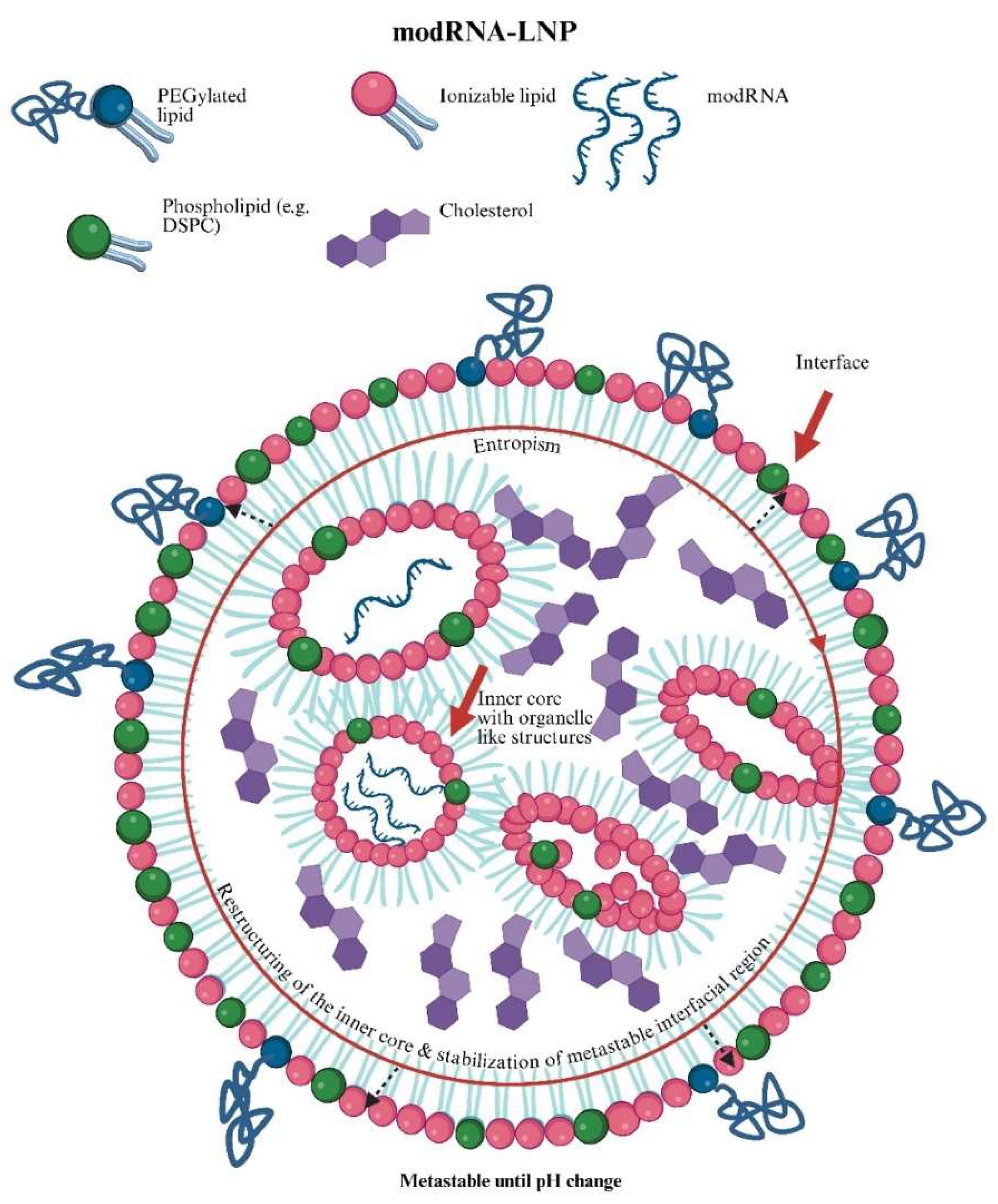
LNPs are often seen as delivery vehicles for nucleic acids, but their biological activity goes beyond payloaded transport. Their physicochemical properties, particularly those of ionizable lipids, render them inherently biointeractive (Figure 1). These lipids are engineered to undergo charge transitions in response to their local environment [5], enabling membrane interaction, bilayer penetration, and endosomal escape [6,7]. We propose LNPs act as active modifiers of membrane structure and function rather than passive carriers; cryogenic transmission electron microscopy (Cryo-TEM) indicates that LNPs lack a hollow aqueous core or stable internal membrane bilayers [2,8]. Instead, the encapsulated ribonucleic acid is intimately associated with ionizable lipids through electrostatic interactions [9]. The negatively charged phosphate backbone of the ribonucleic acid interacts directly with positively charged or protonatable lipid headgroups, forming a compact, disordered lipid-nucleic acid core [10] that reflects a metastable, non-crystalline lipid-nucleic acid assembly capable of structural reorganization, including bleb formation [11].
LNPs are stabilized predominantly by weak, non-covalent interactions, including electrostatic attraction, van der Waals forces, and hydrophobic effects [8,10]. No single interaction maintains structural integrity; stability arises from the collective interactions and flexibility of lipids and nucleic acids. The core is best seen as a dynamic network stabilized by the high configurational freedom of its components rather than from fixed architectural elements [12].
Consequently, the outer lipid shell of forms through spontaneous self-organization of lipids at the interface, not via an internal scaffold or layered membrane system [2]. This structure is sufficiently stable to permit formulation, storage, and systemic transport [13], yet it remains deliberately metastable [14]. Its metastability enables structural rearrangements in response to environmental cues, such as pH shifts or membrane contact, thereby facilitating cellular uptake and release of nucleic acid payload.
Given these properties, LNPs are best described as supramolecular assemblies rather than fixed molecules [15]. Their behaviour reflects their multiparticulate, dynamic, and colloidal nature, with structure arising from collective interactions [16]. This distinction is not merely semantic; it has implications for how LNPs are perceived, their interactions with biological systems, their responses to environmental stimuli, and their structural transitions in vivo.
Having outlined key structural and organizational features of LNPs, it is necessary to briefly discuss how these structures function in vivo. Such a discussion is essential to bridge the gap between formulation design concepts derived from physicochemical considerations and the actual biological behavior of LNPs after administration.
In biological environments, LNPs are exposed to complex and heterogeneous conditions, including variable pH, ionic strength, protein coronas, and membrane interfaces. Under these conditions, their colloidal organization enables adaptive responses that may not be readily predictable from static structural models alone. As a result, LNPs may exhibit emergent nonlinear biological effects stemming from the interplay among particle composition, membrane interactions, and cellular context. Understanding these behaviors requires explicit consideration of both their physicochemical design principles and their dynamic reorganization in vivo. This structural characterization describes LNPs in isolation. To fully evaluate their biological impact, it should be considered how these metastable assemblies may behave in the complex environment of living systems.
Read the preprint here: https://www.preprints.org/manuscript/202511.0517
Falko Seger is a self-taught, autodidactic analyst with many years of independent study. His focus lies on complex systemic issues at the interface of LNP-modRNA technology and cellular and systems biology. Without a formal academic career, but with strong analytical and network-based thinking, he works critically and independently, paying particular attention to consistency, methodology, and internal contradictions in established narratives. His work is characterized by methodological rigor and a non-institutional perspective.
Follow the work on Substack.
Once a week, this webinar series brings a focus to science as it applies to public issues of concern. The webinar brings to you expertise from scientists, researchers, data analysts, medical professionals, health advocates, attorneys, and more, all with the opportunity to learn, ask questions, and hear directly from people working at the leading edge.
Join us!

If you like what you see, and you’re willing and able, consider leaving a tip. Thank you!